If the word “budget” makes you picture a joyless spreadsheet and a life without iced coffee, take a breath. A budget is not a punishment. It is just a plan for your money so you can stop guessing, stop stressing, and start making decisions on purpose.
I built my first real budget after my debit card got declined at the grocery store. It was the kind of humiliating moment that sticks with you. The good news is that budgeting basics are simple, and you can set up your first budget in one sitting.

Below is the exact step-by-step process I teach to beginners. No jargon, no perfection required.
Step 1: Pick a budget home (keep it simple)
You need one place where your budget lives. That is it. Choose the option you will actually use:
- Notes app or paper: Great if you want zero friction.
- Spreadsheet: Best if you like totals adding themselves up.
- Budget app: Helpful if you want automation, but not required.
If you are stuck deciding, pick a spreadsheet. It is flexible, free, and easy to adjust when real life happens.
Step 2: Calculate your monthly income (the safe way)
Your budget starts with what you can reliably spend. Use your net income, meaning the amount that hits your bank account after taxes and benefits.
If you get paid a steady salary
- Add up your paychecks for one month.
- If you are paid every two weeks, you can multiply one paycheck by 2 as a conservative baseline. For a more accurate monthly number, use paycheck × 26 ÷ 12 and remember that two months per year have three paychecks.
If your income varies (tips, commissions, freelance, gig work)
Pick an income number that will not leave you scrambling:
- High volatility: Use your lowest month from the last 3 to 6 months.
- Moderate volatility: Use a 3 to 6 month average, then shave 5% to 10% off or build in a small buffer.
The goal is a budget that works in a normal month, not only your best month.
Step 3: List your expenses (start with what must be paid)
Open your bank and credit card statements for the past month. You are not judging yourself here. You are gathering facts.
A quick way to organize expenses
- Fixed bills: rent or mortgage, car payment, insurance, daycare, subscriptions.
- Variable needs: groceries, gas, utilities, medications, basic household items.
- Financial goals: debt payments, sinking funds, savings.
- Fun and flexible: eating out, hobbies, shopping, entertainment.

Do not forget non-monthly expenses. If you pay car insurance every 6 months or renew a subscription yearly, we will handle that in Step 6 with sinking funds.
Step 4: Choose a beginner-friendly method
There are a lot of budgeting systems, but you only need one that feels doable right now. Here are three that work great for beginners.
Option A: The 50/30/20 guideline
This is a simple way to divide your take-home pay:
- 50% Needs: housing, utilities, groceries, transportation, minimum debt payments.
- 30% Wants: fun, dining out, shopping, travel.
- 20% Goals: extra debt payoff, emergency fund, savings.
If your needs are already more than 50%, you are not failing. You are just in a high-cost season. Use the framework anyway and adjust the percentages to fit reality.
Option B: Zero-based budgeting
With zero-based budgeting, you give every dollar a job until you hit zero:
- Income minus planned spending (including savings and debt payoff) equals 0.
- Zero does not mean you spent it all. It means you assigned it on purpose.
This is my personal favorite when you are trying to stop overdrafts or break the paycheck-to-paycheck cycle.
Option C: The three buckets budget
- Bills bucket: all fixed bills and minimum payments.
- Spending bucket: groceries, gas, fun, daily life.
- Goals bucket: savings and extra debt payments.
This is simple, flexible, and surprisingly effective.
Step 5: Set limits you can live with
This is where most first budgets go off the rails. People set “aspirational” numbers and then feel like a failure by day five.
Instead, use a two-step approach:
1) Start with your real spending
Look at last month and write down what you actually spent in each category (groceries, dining out, gas, etc.). That is your baseline.
2) Make small, strategic changes
Pick one or two categories to tighten first. For example:
- Reduce dining out by $50 this month.
- Reduce online shopping by $40.
- Increase groceries by $30 if you are trying to eat at home more.
Budgets work when they are realistic, not when they are strict.
A quick reality check
Income minus fixed bills minus minimum debt payments equals what you have left for groceries, gas, fun, and goals.
If the “what you have left” number is scary small, that can be a sign of an income or fixed-cost squeeze. It can also mean you are missing a category (hello, irregular expenses) or dealing with heavy minimum payments. Either way, budgeting helps because it shows you the truth clearly, and truth is where solutions start.
One non-negotiable: cover your minimums first (rent, utilities, minimum debt payments). Extra debt payoff is awesome, but stability comes before speed.
Step 6: Add sinking funds
A sinking fund is money you set aside monthly for expenses you know are coming, just not this month.
Common sinking funds:
- Car repairs and maintenance
- Medical copays and prescriptions
- Holiday gifts
- Annual subscriptions
- School costs
- Travel
How to calculate it:
- Pick one upcoming expense, like a $600 car insurance bill due in 6 months.
- Divide it: $600 ÷ 6 = $100 per month.

If you prefer to keep it all digital, you can use separate savings buckets at your bank or a dedicated savings account.
Step 7: Track your budget (least annoying wins)
Tracking is the part that makes the budget real. The best tracking system is the one you will keep doing.
Simple tracking options
- Weekly money date (15 minutes): Check balances, update categories, adjust.
- Receipt roundup: Enter purchases once per day while you brush your teeth.
- Bank check-in: Every other day, scan recent transactions and categorize them.
If you only do one thing: do a weekly money date. Put it on your calendar like an appointment, because it is one.
If your pay cycle is weekly or biweekly, feel free to budget by paycheck instead of by month. The idea is the same, you are just assigning dollars when they arrive. It also helps to list bill due dates so you can line them up with the paycheck that will cover them.
Step 8: Adjust mid-month (because life happens)
Your first budget will not be perfect. That is normal. A budget is a living plan, not a one-time math problem.
When you overspend in one category, you have three choices:
- Move money from another category (totally allowed).
- Pause spending in that category for the rest of the month.
- Increase income with extra hours, a side gig shift, or selling something you do not need. Just remember that selling something is a one-time boost, not a long-term plan.
Budgeting win: catching the problem mid-month and adjusting.
Budgeting loss: ignoring it and hoping it fixes itself.
Also, please do not punish yourself by cutting groceries to “make up for it.” That usually leads to a spending rebound later.
A beginner budget example
Here is what a simple monthly budget could look like if your take-home pay is $3,200.
| Category | Monthly Amount |
|---|---|
| Rent | $1,200 |
| Utilities | $180 |
| Internet and phone | $120 |
| Car payment | $300 |
| Car insurance sinking fund | $100 |
| Groceries | $450 |
| Gas and transit | $160 |
| Minimum debt payments | $200 |
| Emergency fund | $150 |
| Dining out | $140 |
| Fun and personal | $120 |
| Miscellaneous buffer | $80 |
| Total | $3,200 |
Notice the buffer. That little cushion is what keeps a budget from falling apart when something small pops up.
Also, the emergency fund line is there on purpose. If you are starting from zero, a first target like $500 to $1,000 can make a huge difference before you worry about bigger goals like 3 to 6 months of expenses.
Common first-budget mistakes
Mistake: Forgetting irregular expenses
Do instead: Start one sinking fund this month, even if it is only $25.
Mistake: Setting every category too low
Do instead: Base your first budget on your real spending, then lower just 1 to 2 categories.
Mistake: Tracking only when you feel guilty
Do instead: Pick a repeating time (Sunday afternoon, Wednesday night) and keep it short.
Mistake: Treating the budget like a morality score
Do instead: Treat it like a GPS. If you take a wrong turn, you reroute. You do not shame yourself for needing directions.
Quick-start checklist
- Choose your budget tool (notes, spreadsheet, or app).
- Total your monthly take-home income.
- List fixed bills and due dates.
- Pull last month of transactions and estimate variable categories.
- Add one sinking fund and one small buffer.
- Schedule a weekly 15-minute check-in.
If you do those six things, you officially have a budget. More importantly, you have clarity.
FAQ
How long does it take to make your first budget?
Most people can build a first draft in 30 to 60 minutes if they have their bank and credit card transactions handy. Your second month is faster because the categories already exist.
Should I budget with cash envelopes or a card?
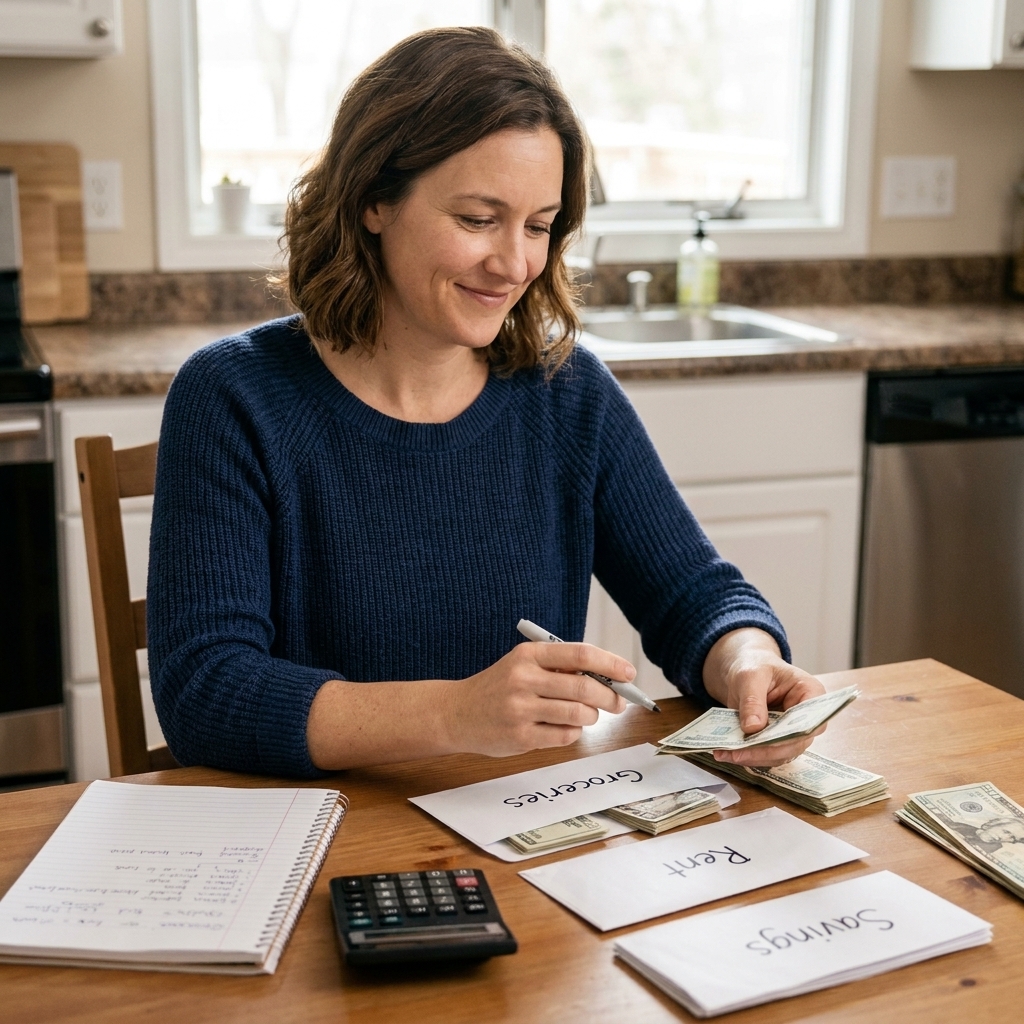
Either works. Cash envelopes can be great for categories where you tend to overspend (like dining out). Cards are more convenient and easier to track automatically. You can also do a hybrid: cash for problem categories, card for everything else.
What if my income is irregular?
Budget using either a conservative average (with a buffer) or your lowest recent month, depending on how unpredictable your income is. Then treat any extra income as a bonus to fund priorities: catching up on bills, building a buffer, paying down debt, or boosting savings.
What if I keep blowing my budget?
That usually means one of a few things: your limits are too tight, you are missing a category (like gifts or car repairs), your bill due dates are fighting your pay cycle, or your fixed costs are too high for your income right now. The fix is not willpower. The fix is adjusting the plan until it fits your real life.