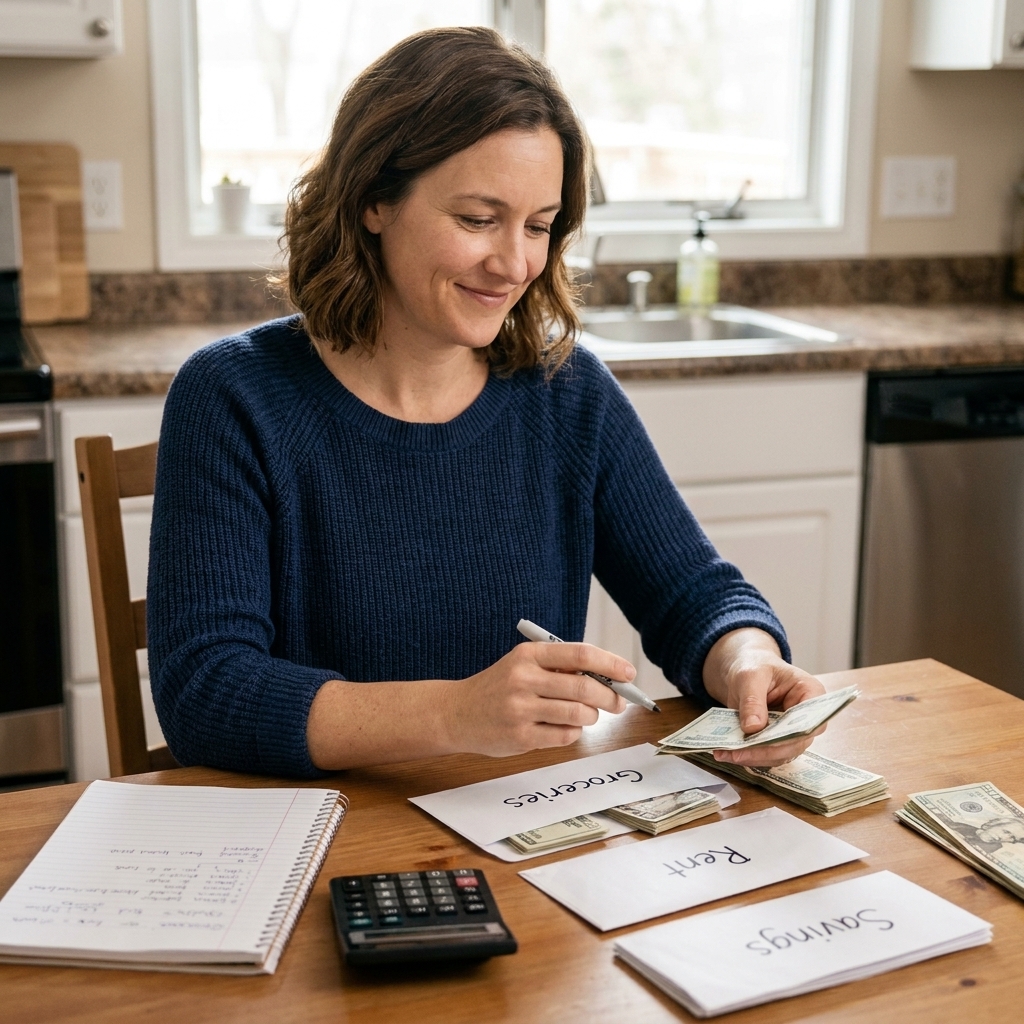
If you have ever looked at your bank account and thought, “This month I am doing fine,” and then blinked and thought, “Wait, where did it go,” welcome.
Irregular income is emotionally exhausting because it turns normal life bills into mini emergencies.
The good news is you do not need perfect predictions to budget well. You need a plan that assumes your income will vary, protects your basics first, and builds a buffer so your money stops yanking you around month to month.

Below is the exact framework I wish someone handed me when I was stressed, broke, and trying to make a grown-up budget work with not-so-grown-up paychecks.
Start with the goal: stability
With a steady paycheck, budgeting is often about optimizing. With irregular income, budgeting is about stabilizing.
That means your budget should answer three questions:
- What must be paid no matter what? (Housing, utilities, minimum debt payments, groceries, insurance.)
- How will I pay myself when income swings? (A simple system for moving money into “buckets.”)
- What will I do during a low month? (A buffer plan you build on purpose, not on panic.)
If you can nail those, the rest is just fine-tuning.
Step 1: Find your baseline income
The biggest mistake I see freelancers make is budgeting off their best month. It feels motivating, but it sets you up to “fail” your budget the minute your workload dips.
Pick a baseline you can trust
Choose one of these methods:
- Conservative average: Add up your last 6 to 12 months of income and divide by the number of months, then subtract 10% to 20% as a cushion.
- Lowest typical month: Look at the lowest month in the last year that was not a total fluke, and use that as your baseline.
- 3-month low average: Average your three lowest months from the last year. This often creates a baseline that is realistic but not overly bleak.
If your income is brand new and you do not have history yet, start with a baseline that covers only essentials, then adjust after 90 days of real data.
Use net cash, plan for taxes
Budget with the money that actually hits your bank account, but do not ignore taxes.
- If you are self-employed, you will likely need to set aside money for federal, state, and self-employment taxes.
- Many people start with a rule of thumb around 25% to 35% of profit, but the right number depends on your income, deductions, filing status, and location. Some situations need more.
If you are not sure, a quick call with a tax pro for a one-time “estimated taxes checkup” can save you from a nasty surprise later.
Step 2: List expenses by priority
When income is unpredictable, your budget needs a pecking order. Not everything gets paid “because it is in the spreadsheet.” It gets paid because it is a priority.
Create four tiers
- Tier 1: Non-negotiables (rent or mortgage, basic utilities, car payment, insurance, minimum debt payments, prescriptions)
- Tier 2: Survival spending (groceries, gas or transit, basic phone, essential work tools)
- Tier 3: Stability builders (starter emergency fund, sinking funds, extra debt payments)
- Tier 4: Lifestyle (restaurants, subscriptions, shopping, travel, upgrades)
In high-income months, you can fund all tiers. In low-income months, you protect Tier 1 and Tier 2 first, then scale down from there without shame.

Turn big expenses into sinking funds
Irregular income feels harder when irregular expenses show up too. The fix is sinking funds, which are just small monthly amounts for future bills.
Common sinking funds for freelancers and gig workers:
- Car repairs and maintenance
- Annual subscriptions or software
- Quarterly taxes
- Medical out-of-pocket costs
- Gifts and holidays
- Business equipment replacement (laptop, phone)
Step 3: Build your buffer first
If I could tattoo one money lesson on my past self, it would be this: the buffer is the budget when your income is irregular.
A buffer is cash you keep available so slow weeks do not immediately turn into late fees, overdrafts, or credit card swipes.
How much buffer is enough?
- Starter buffer: $500 to $1,000
- Stability buffer: 1 month of core expenses (Tier 1 + Tier 2)
- Stress-reducing buffer: 2 to 3 months of core expenses
These are common targets, not moral requirements. If you are a single-income household, have dependents, have high fixed costs, or do seasonal work, you may want a larger cushion over time.
Start where you are. Even $300 can stop a spiral.
The simplest way to build it
In every payment cycle, treat your buffer like a bill:
- Set a small, consistent transfer amount (even $25 or $50).
- Increase it during high-income weeks.
- Do not pause it unless you are in a true emergency.
Where to keep the buffer
A separate high-yield savings account is often a good fit. You want it close enough to use, but not so close you casually spend it. If your bank has transfer delays, consider keeping a small slice in checking as a first-line cushion.
Step 4: Pay yourself on purpose
One of the most calming things you can do with irregular income is stop living directly off every deposit.
Instead, collect income, then pay yourself a set amount on a schedule. You are basically becoming your own payroll department.
Here are two easy versions.
Option A: Monthly owner draw
- All income goes into one main account.
- On the 1st (or your chosen date), you transfer your budgeted “monthly paycheck” to your spending account.
- Anything extra stays as buffer, taxes, or savings goals.
Option B: Weekly paycheck
- Pick a weekly payday (like Fridays).
- Transfer the same amount each week to cover your weekly spending categories.
- High-earning weeks build the buffer. Low-earning weeks do not wreck your life.
If you are thinking, “But what if I cannot afford a consistent amount?” That is exactly what the baseline income step is for. Start conservative, then raise your “salary” after three stable months.
Step 5: Treat taxes like a bill
Taxes can be the biggest irregular-income budget buster because the bill arrives later, when the money feels long gone.
To make this boring (the goal), set up a system:
- Open a separate tax savings account.
- Automatically set aside a percentage of each payment the day it arrives.
- Do not spend it. Not for a “temporary” cash crunch. Not for a slow week. Not for a surprise flash sale.
If you want an extra safety layer, you can pay estimated taxes as you go. Some people prefer to hold tax money in savings until quarterly deadlines for cash flow. Either way works if you are setting aside enough and paying on time.
Step 6: Make slow months survivable
Slow months are not a character flaw. They are a normal feature of freelance and gig work. Your budget should treat them as expected.
Create a lean-month plan
Write down what you will do if income drops. Not in a panicky way. In a calm, pre-decided way.
- Freeze Tier 4 spending immediately (restaurants, shopping, nonessential subscriptions).
- Switch to a lean groceries plan for two to four weeks.
- Pause extra debt payments temporarily (keep minimums).
- Use sinking funds for their intended purpose so surprise bills do not hit your credit card.
- Pull from buffer last and refill it as soon as income returns.
Debt: buffer first, then attack
If you are juggling debt and an irregular paycheck, a small buffer usually comes first. A starter buffer can keep you from adding new credit card debt during a low month.
After that, focus extra payments where they matter most. High-interest debt (often credit cards) tends to be the priority. Lower-interest debt can usually take a back seat in lean months, as long as you stay current on minimums.
Reduce fixed costs
Irregular income and high fixed expenses are a stressful mix. If your budget feels impossible, look here first:
- Housing costs (roommate, renegotiate lease at renewal, house hack, relocate if possible)
- Car costs (insurance shopping, refinance, sell and downsize if realistic)
- Subscriptions (keep only what you truly use)
- Phone and internet plans (promotions and MVNOs can save a lot)

You do not need to live like a monk. You just need enough wiggle room that a slow month does not turn into a crisis.
Step 7: Track income like a pro
You do not need fancy software. You do need visibility.
Do a weekly money check-in
Set a 15-minute appointment with yourself once a week. Same day, same time.
- Update your income received
- Confirm upcoming bills due before next check-in
- Move money to taxes and sinking funds
- Check your buffer balance
- Decide if this is a “normal” week or a “lean” week
Use a simple pipeline
Irregular income feels scarier when your brain treats it as random. Make it more predictable by listing your expected money in three columns:
- Booked: confirmed work with a known pay date
- Likely: strong leads and recurring clients
- Maybe: inquiries, proposals sent, auditions, etc.
Only “Booked” should influence your short-term bill planning. “Likely” and “Maybe” help you see if you need to hustle harder or cut spending early.
Do not ignore invoice delays
If you invoice clients, your “income” is not the day you finish the work. It is the day the money clears your account. Track invoices and expected pay dates (Net 15, Net 30, Net 60), and build that delay into your buffer plan so you are not paying today’s bills with next month’s money.
Separate money without overcomplicating it
At minimum, keep clear buckets for personal spending, taxes, and your buffer. If you can do separate accounts, a simple setup is:
- Income account: where client payments land
- Tax account: taxes only
- Spending account: your “paycheck” transfers and bill pay
This is not about being fancy. It is about making it harder to accidentally spend money that already has a job.
Example: A realistic budget
Let’s say your last 12 months averaged $4,200 per month, but it swings from $3,100 to $5,800. You choose a conservative baseline of $3,600.
| Category | Monthly amount | Notes |
|---|---|---|
| Tier 1: Non-negotiables | $1,900 | Rent, utilities, insurance, minimum debt |
| Tier 2: Survival spending | $650 | Groceries, gas, phone |
| Taxes set-aside | $700 | About 20% of baseline, adjust to your situation |
| Sinking funds | $200 | Car, annual expenses, medical |
| Buffer build | $100 | Starter buffer first, then 1 month core expenses |
| Lifestyle (Tier 4) | $50 | Small, intentional fun money |
Total: $3,600. That matters. When the math matches your baseline, your budget stops feeling like a motivational poster and starts feeling like a plan.
In a $5,000 month, the extra $1,400 does not become lifestyle creep. It becomes progress: finish your buffer, top up sinking funds, catch up on goals, then enjoy a planned treat.
Common mistakes
Mistake: Spending the good month money
Instead: Treat big months as your buffer-building months. Let them protect you from the next slow stretch.
Mistake: Saving for everything except taxes
Instead: Make tax transfers automatic. Future-you deserves that kindness.
Mistake: Using credit cards as the buffer
Instead: Build a real cash buffer. Credit cards are expensive stress.
Mistake: Mixing business and personal money
Instead: If you can, use separate accounts. At minimum, separate buckets. Clarity is half the battle.
FAQ
How do I budget if my income changes every week?
Use a weekly paycheck approach. Decide on a conservative weekly transfer amount based on your baseline income, then let high weeks feed your buffer and low weeks pull from it. Your spending can be consistent even if your deposits are not.
Should I budget using my lowest month?
If your income is extremely volatile, budgeting off a low month can reduce anxiety. The downside is it can feel tight. A good middle ground is averaging your three lowest months, then building a buffer so you are not always living at the edge.
How big should my emergency fund be if I freelance?
Aim for at least one month of core expenses (Tier 1 and Tier 2) as your first major milestone. Two to three months is a strong next target for many freelancers, especially if your work is seasonal. If you support others or have high fixed costs, you may want more.
What if I cannot build a buffer because I am behind on bills?
Start tiny and strategic: $10 to $25 per deposit while you stabilize. At the same time, reduce fixed costs, ask for hardship plans, and use a lean-month plan for spending. Once you are current, increase buffer contributions quickly during your next strong month.
A final pep talk
Irregular income budgeting is not about being “good with money.” It is about building a system that can handle reality. Some months will be great. Some months will be weird. The goal is to make sure none of those months wreck your sleep.
If you want one simple next step: pick your baseline income today, then open or label a separate buffer account and put your first transfer in it, even if it is small. Stability is built one boring decision at a time.