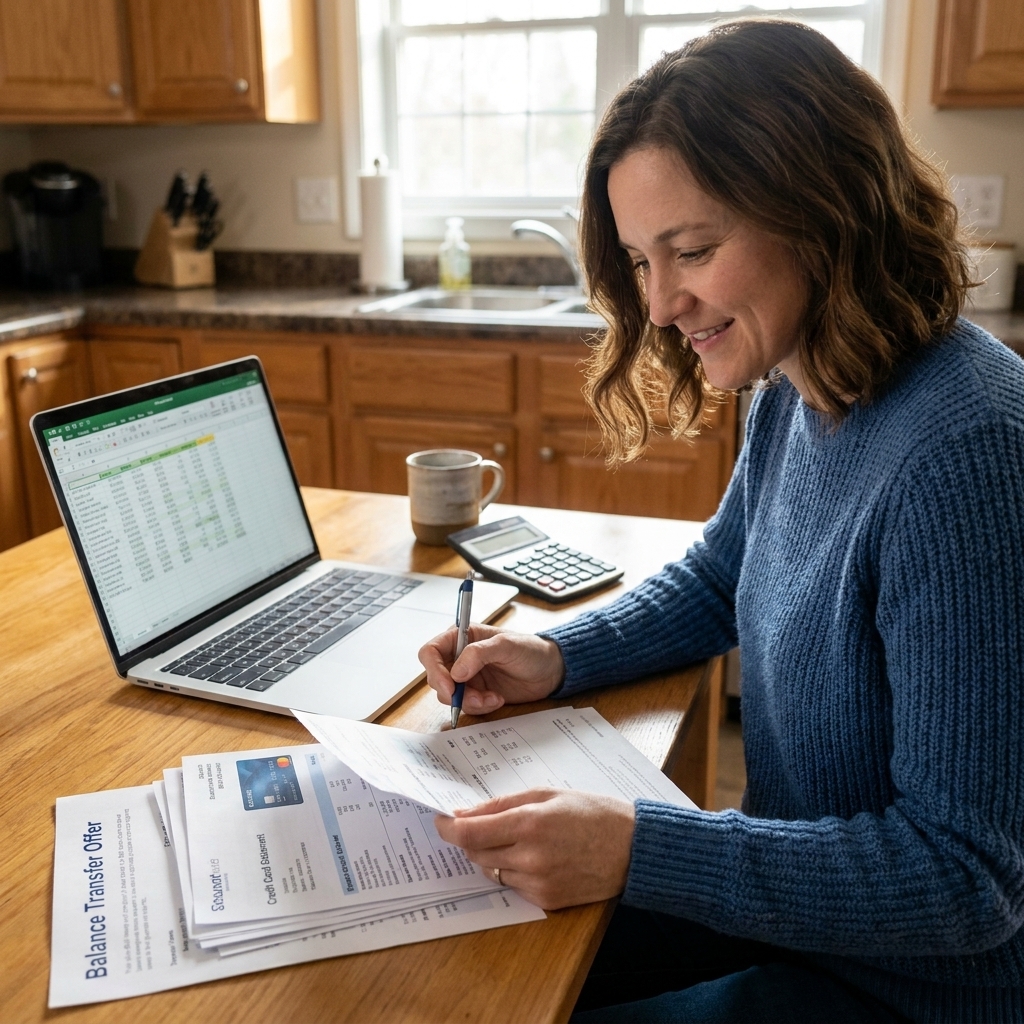
I used to treat my credit card like a life raft. Groceries. Gas. One more “emergency” that wasn’t really an emergency. Then one day my debit card was declined at a grocery store, and I realized I had built my whole life on quick fixes.
If you are staring at a credit card balance that won’t budge, you are not broken. Credit card pricing and minimum-payment formulas can keep balances lingering for years. The good news is: you can beat it with a simple, repeatable system.
This guide walks you through exactly how to pay off credit card debt fast, without complicated finance talk, and without pretending you can live on ramen and willpower.

Step 1: Freeze the damage (stop adding new charges)
Before we talk about payoff methods, we have to stop the bleeding. If you’re still charging basics, you are trying to drain a bathtub while the faucet is running.
Do this today
- Switch to a debit card or cash for daily spending for the next 30 days.
- Remove saved cards from Amazon, DoorDash, Walmart, Target, app stores, and your browser autofill.
- Put the physical card out of reach (freezer-in-a-bag works, or lockbox, or give it to a trusted person).
- Turn on purchase alerts so every swipe pings your phone. Awareness is powerful.
If you truly need the card for something specific (like a work travel hold or a single subscription), keep one card active and make a written plan for how it will be paid in full that month.
Step 2: Get crystal clear on what you owe (one-page debt list)
Not knowing the numbers makes everything feel scarier. We are going to replace “doom scrolling my balance” with a simple snapshot.
Make a list with these columns
- Card name
- Balance
- APR (interest rate)
- Minimum payment
- Payment due date
You can pull this from your online accounts in 10 minutes. If you have multiple cards, this list is your command center.

Step 3: Build a debt payoff budget (small, realistic, repeatable)
You do not need the perfect budget. You need one that creates monthly breathing room for extra payments.
The fastest way to find extra money
- Start with essentials: housing, utilities, groceries, transportation, insurance.
- Cap the big three leaks: food delivery, convenience spending (little purchases that add up, like drinks, snacks, impulse buys), subscriptions.
- Create a weekly spending limit for everything else (weekly works because it keeps you from “oops-ing” the whole month by day 10).
Your target: free up at least $100 to $300 extra per month if possible. Even $50 matters, but momentum comes faster with a bigger gap.
My favorite mindset shift
Think of extra debt payments like buying back your paycheck. Every dollar that stops going to interest becomes money you get to keep.
Step 4: Choose your payoff method (avalanche or snowball)
There are two solid approaches. Both work. The best one is the one you will stick with when life gets annoying.
Debt avalanche (fastest mathematically)
Pay minimums on everything. Put every extra dollar toward the card with the highest APR first.
- Best if: your interest rates are high, you want the quickest total payoff, you can stay motivated without quick wins.
Debt snowball (fastest emotionally)
Pay minimums on everything. Put every extra dollar toward the card with the smallest balance first.
- Best if: you feel overwhelmed, you need early wins, you have multiple small balances.
My honest take: if you are in a shame spiral, start with snowball. Confidence is a strategy. If you are steady and numbers-driven, avalanche usually saves more on interest.
| Method | Focus first | Why it works | Watch out for |
|---|---|---|---|
| Avalanche | Highest APR | Less interest overall | Progress can feel slow at first |
| Snowball | Smallest balance | Quick wins build momentum | May pay more interest long-term |
Step 5: Lower your interest rate (this is where fast comes from)
If you do nothing else besides make extra payments, you will still make progress. But if you want to move fast, you need to attack the APR.
Option A: Call and ask for a lower APR
This can take as little as 10 minutes and, if they approve you, it can save you significantly over time.
Simple script you can read
“Hi, I’m calling to request a lower interest rate on my account. I’ve been a customer for a while, and I want to pay this balance down faster. Can you reduce my APR or offer a promotional rate?”
- If they say no: ask if there is a hardship program, a promo APR, or a temporary reduction.
- If you have good payment history: mention it.
- If you get transferred: stay polite and keep asking.
Option B: 0% balance transfer (powerful, but only if you follow the rules)
A 0% APR balance transfer can be amazing if you stop using the card and you can pay the balance off before the promo ends.
- Watch the transfer fee: often 3% to 5% of the amount moved.
- Know the promo length: often 12 to 21 months, but it varies by offer.
- Do the math: balance ÷ promo months = monthly payment target.
- Do not add new purchases on the transfer card unless you plan to pay them off immediately. Mixing balances can get messy.
Two gotchas people miss: if you make a late payment, some issuers can end the promotional rate, and when the promo period ends the remaining balance usually switches to the regular APR. Also, opening a new card can create a hard inquiry and shift utilization, so expect your score to wiggle a bit while the bigger plan pays off.
Option C: Debt consolidation loan (helps when your credit card APRs are brutal)
A personal loan can turn revolving debt into a fixed payoff timeline. The win is a lower interest rate and one set payment.
- Best if: you can qualify for a meaningfully lower APR, and you will not run the cards back up.
- Not great if: the loan APR is close to your cards, or the payment strains your budget.
Option D: Credit counseling (legit help for high stress situations)
If payments are slipping, look for a nonprofit credit counseling agency that offers a debt management plan (DMP). They may be able to lower rates and create a structured payoff.
Make sure you are signing up for a DMP, not debt settlement. A good agency will be transparent about fees and outcomes, and you can look for accreditation through groups like the NFCC or FCAA.
Avoid companies that promise to “erase” debt or pressure you to stop paying your creditors without explaining consequences.
If you are facing lawsuits, wage garnishment threats, or you truly cannot meet basic expenses, it may be worth talking to a qualified bankruptcy attorney for a clear read on your options.
Step 6: Automate your system (so motivation is optional)
Paying off debt fast is less about being “disciplined” and more about removing decision fatigue.
Automation setup (15 minutes)
- Autopay minimums on every card to avoid late fees and credit damage.
- Schedule your extra payment 1 to 2 days after payday to your target card (avalanche or snowball focus).
- Split payments if you get paid biweekly: half the extra payment each paycheck can feel easier.
Extra tip: if your card calculates interest based on an average daily balance method, making payments earlier in the month can reduce interest costs. You can confirm how your card calculates interest in the terms or the Schumer box.
Step 7: Find more payoff fuel (without burning out)
If your budget is already tight, the fastest lever is usually income. It does not have to be forever. Think “season of intensity,” not “new personality.”
Quick wins that actually work
- Sell a few high-value items: old phones, tablets, unused tools, brand-name clothes.
- Pick a short-term side gig: weekend shifts, delivery driving, pet sitting, babysitting, freelancing.
- Negotiate one bill: car insurance, internet, phone plan. A $30 monthly cut is $360 a year.
- Use windfalls on purpose: tax refund, bonus, cash gifts. Decide the percentage you will put toward debt before it hits your account.

Step 8: Stop the swipe cycle (so the debt stays gone)
Paying it off is one thing. Keeping it off is the real flex.
Build a tiny buffer first
If you have zero savings, every surprise becomes a credit card charge. Aim for:
- $500 starter emergency fund while you pay off debt, then
- 1 month of expenses, then
- 3 to 6 months longer term
Replace credit card emergencies with sinking funds
Sinking funds are mini savings buckets for predictable stuff that still feels like an emergency when you do not plan for it.
- Car repairs
- Medical copays
- Back-to-school
- Holidays
- Vet bills
Create rules for future credit card use
- Use the card only for budgeted purchases.
- Pay the balance in full weekly or after each payday.
- Never carry a balance “just this month.” That is how it restarts.
What paying off credit card debt fast looks like (example)
Let’s say you owe $6,000 at 24% APR, and you can afford $250/month.
- At 24% APR, paying $250/month could take roughly 34 months, and you could pay around $2,400 in interest (estimates vary by issuer and how interest is calculated).
- If you moved the balance to a 0% promo and paid $250/month, you would knock it out in about 24 months, and the main added cost would typically be the transfer fee.
This is why I push the “lower the APR” step so hard. You cannot hustle your way out of a bad interest rate as efficiently as you can negotiate or restructure it.
Common mistakes that keep people stuck
- Only paying the minimum. Minimum payments are designed to stretch repayment out for years.
- Closing every card immediately. Sometimes closing makes sense, but do it strategically. If closing a card hurts your credit utilization or you will just open new cards later, it can backfire.
- Using a balance transfer like a fresh start. It is a tool, not a reset button. If spending habits do not change, the debt doubles.
- Trying to do it all with willpower. Automation beats motivation every time.
- Ignoring late fees. A late fee plus penalty APR can undo a whole month of progress.
FAQ
Should I pay off the smallest balance or the highest interest first?
Highest interest (avalanche) is usually fastest in total dollars. Smallest balance (snowball) is often fastest for motivation. Pick the one you will follow for 6 to 12 months without changing the plan every two weeks.
Is it bad to use a credit card while paying off credit card debt?
It depends. If you pay the card off in full and never carry a balance, using a card for points can be fine. If you are carrying balances, I recommend pausing new charges until you have control and a starter emergency fund.
Will paying off credit cards improve my credit score?
Often yes, especially if your credit utilization drops. You can see improvements even before you hit zero. Keep paying on time, every time.
What if I cannot afford more than the minimum payment?
First, make sure your budget covers essentials and you are not missing any assistance options. Then focus on lowering APR, cutting one bill, and finding even a small temporary income boost. If you are falling behind, consider nonprofit credit counseling to explore structured help.
Your quick-start checklist
- Stop new charges for 30 days
- Write your one-page debt list
- Find $100 extra in your budget (or any amount you can)
- Pick avalanche or snowball and commit
- Call for a lower APR
- Automate minimums and your extra payment
- Build a $500 starter emergency fund