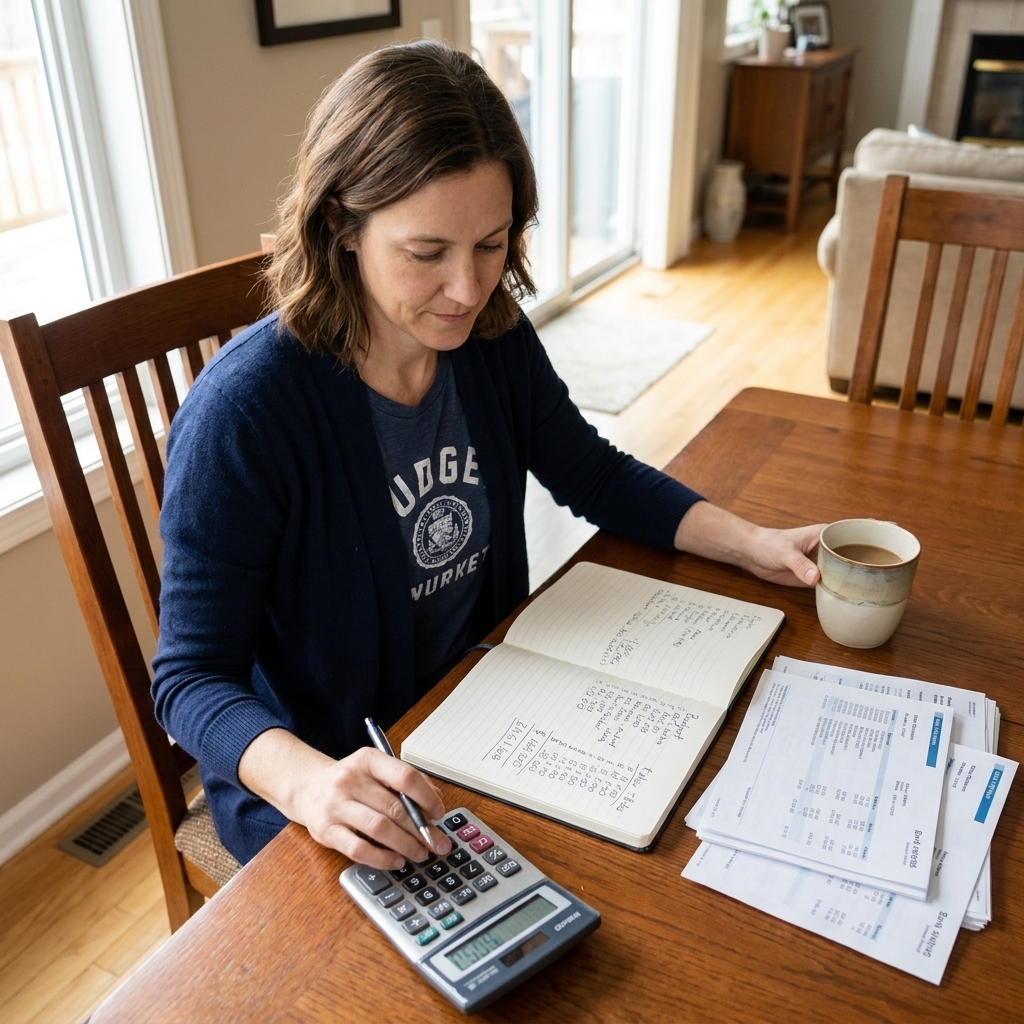
The 50/30/20 budget rule is popular for one simple reason: it makes saving feel like a bill you pay first, not something you try to do “if there’s anything left.”
Here’s the core idea: you divide your money into three buckets.
- 50% for needs (must-pay basics)
- 30% for wants (fun and lifestyle)
- 20% for savings (and often extra debt payoff)
In this guide, we are going to do the part most people skip: how to set it up so a real 20% actually leaves your checking account each month and lands on purpose.

What the rule means
The rule is a framework, not a personality test. You are not “bad with money” if your percentages are off right now. The point is to build a plan that:
- covers your essentials
- lets you enjoy your life without guilt
- moves you forward every month
Important: 50/30/20 is usually based on after-tax take-home pay, meaning what actually hits your bank account. “Take-home” can be defined a couple ways depending on what comes out of your paycheck (taxes, benefits, retirement). If you contribute to retirement or an HSA through payroll, you can count those contributions toward your 20%. Just be consistent about which number you use, and see the payroll section below for an easy way to choose.
Quick definitions
- Needs (50%): housing, utilities, basic groceries, minimum debt payments, insurance, required transportation, childcare, prescriptions
- Wants (30%): restaurants, subscriptions, hobbies, upgrades (nicer apartment than you need, premium phone plan), travel, convenience spending
- Savings (20%): emergency fund, sinking funds, retirement contributions (especially if they are not already coming out of your paycheck), extra debt payments, investing, big goals like a home down payment
If you are thinking, “Wait, debt payoff is savings?” In this context, extra payments beyond the minimum belong in the 20% bucket because they build net worth the same way saving does.
Step 1: Find your take-home pay
To make 20% consistent, you need one clean number to build around.
If you are paid a salary
Look at the amount deposited into your bank account each paycheck. Multiply by the number of paychecks you receive per month, or convert to a monthly average if you are paid every two weeks.
- Paid twice a month: take-home per check × 2
- Paid every two weeks: take-home per check × 26, then divide by 12
If your income is irregular
Use a “safe” baseline so you do not accidentally over-commit. Pick one:
- Last 3 months average take-home pay
- Lowest month from the last 6 months (most conservative)
When you have a higher-income month, you can send the “extra” to savings or a specific goal without breaking the plan.
Step 2: Do the math
Let’s use a simple example: your take-home pay is $4,000/month.
| Bucket | Percent | Monthly amount |
|---|---|---|
| Needs | 50% | $2,000 |
| Wants | 30% | $1,200 |
| Savings | 20% | $800 |
That $800 is the star of the show. We are going to treat it like rent: due every month, no negotiation.
Step 3: Automate the 20%
When I was getting out of debt, my biggest breakthrough was realizing discipline is overrated. Systems win. If you want a consistent 20% savings rate, set it up so you have to work to stop saving.
Timing tip: If your paycheck lands later in the day or your bank posts deposits at unpredictable times, schedule transfers for the same day or the next business day so you do not trigger overdrafts.
The cleanest setup
On every payday, schedule two automatic transfers (10% of each paycheck):
- 10% to emergency or cash savings
- 10% to a goal (a separate savings account, investments, or an extra debt payment)
Splitting it makes the habit feel easier and keeps you from parking everything in one vague pile.
Where to send the 20%
- Emergency fund (first priority for most people): one common starter target is $1,000, then build toward 3 to 6 months of essential expenses. If $1,000 is not realistic right now, start with $250 to $500 and build from there.
- Sinking funds: car repairs, holidays, annual insurance premiums, vet bills
- Retirement: IRA or increased 401(k) contributions if you can. If your employer offers a match, prioritize contributing enough to get the full match inside your 20% if possible.
- Extra debt payments: highest-interest first is usually fastest mathematically, while the snowball method can help motivation
If you are starting from scratch, a simple first split looks like this:
- 15% to emergency fund until you hit your target
- 5% to a sinking fund for near-term surprises

Step 4: Sort needs vs wants
Here is the most common way the 50/30/20 rule falls apart: everything gets labeled a need. I get it. When money is tight, everything feels necessary because you are trying to keep life running.
Try this filter: If you lost your income tomorrow, would this bill still have to be paid to keep you safe, housed, insured, and employed? If yes, it is probably a need. If not, it is probably a want or a choice inside the need category.
Needs that are truly needs
- rent or mortgage
- electricity, water, heat
- basic groceries (not convenience snacks and impulse treats every trip)
- car payment you cannot avoid, gas for commuting, essential maintenance
- insurance premiums
- minimum debt payments
Common wants in disguise
- upgrading to a bigger apartment because it feels nicer
- premium cable packages
- delivery fees and last-minute convenience spending
- brand-name everything at the grocery store when store brands work fine
Zero shame here. The goal is clarity, not punishment.
Step 5: Cap your wants
Wants are not the enemy. A budget with zero joy is the budget you will abandon.
But the 30% bucket needs guardrails, especially if you are trying to make your savings automatic. Two tactics that work really well:
1) Use a fun money account
Transfer your monthly wants amount into a separate checking account. That account pays for restaurants, hobbies, shopping, and whatever makes life feel like life. When it is empty, you are done for the month.
2) Pick your big three
Choose three categories you care about most (maybe travel, happy hours, and concerts). Spend freely within your 30% on those, and go boring on the rest. This cuts decision fatigue and reduces random spending.

If money is tight
Sometimes the math is the math. If your needs are already above 50%, you cannot squeeze out 20% without changing something.
Here are realistic ways to still make the system work, in order of impact.
Option A: Keep 20% first
If you can do it without missing bills, protect your 20% and split the remaining 80% between needs and wants. For a season, your rule might look like 60/20/20 or 70/10/20. The win is that saving stays protected.
Option B: Stair-step to 20%
If 20% would cause overdrafts today, start at 10% and increase by 1% each month (or every paycheck) until you hit 20%. You are building a habit and buying time to lower expenses.
Option C: Lower your biggest fixed cost
If you need space to save, look here first:
- housing: roommate, refinance, renegotiate lease, move when possible
- transportation: cheaper car, insurance shopping, public transit, carpooling
- debt minimums: lower interest rates, consolidation (carefully), credit counseling if needed
Cutting $100 from a fixed bill beats cutting $10 from coffee repeatedly. It is not as fun, but it works.
Payroll and retirement
This is where a lot of people get stuck, so let’s make it simple.
- If money is deducted from your paycheck before it hits your bank (401(k), HSA, some insurance premiums), it will not show up in your take-home pay number.
- You have two clean options. Use take-home pay and count only what you transfer out of checking. Or use after-tax income before those deductions and count the deductions in your 20%.
The goal is not “perfect.” The goal is that your real savings rate is real, and you can repeat it.
Credit cards and timing
If you use credit cards for points or convenience, budget based on your spending, not when the card payment clears.
Two rules keep this clean:
- Your 20% transfer still happens on payday. Do not wait until you pay the card bill.
- Keep enough cash in your bills account to pay the statement balance. Your categories are tracking purchases; your payment is just the cleanup step.
Examples by income
These are simplified examples, but they show how to think.
Example 1: Take-home pay $2,500/month
- Needs (50%): $1,250
- Wants (30%): $750
- Savings (20%): $500
If your rent alone is $1,250, your needs will exceed 50% and that is common. In that case, you may run a modified plan temporarily (like 70/10/20) while you work on housing or income.
Example 2: Take-home pay $6,000/month
- Needs (50%): $3,000
- Wants (30%): $1,800
- Savings (20%): $1,200
At higher incomes, lifestyle creep is the danger zone. A consistent savings target helps you avoid accidentally spending raises.
Small tweaks that add up
1) Save before you see it
If you have access to retirement through work, consider increasing your 401(k) contribution so part of your 20% never even hits checking. That can make it easier to stick to the plan.
2) Use separate accounts
One of the easiest ways to make saving stick is to remove the temptation to “borrow” from it.
- Bills checking: rent, utilities, minimum debt payments
- Spending checking: groceries, gas, wants
- Savings: emergency fund and sinking funds
3) Name your savings
“Savings” is abstract. “Emergency fund: 3 months” is motivating. So is “Down payment” or “Replace tires.” Specific goals help you stay consistent when willpower is low.
4) Use a scoreboard
Track one number weekly: your savings balance (or debt balance if you are in payoff mode). Watching progress move is how you turn budgeting from punishment into momentum.
Common mistakes
You budget from gross pay
Use after-tax take-home pay, and decide how you want to treat payroll deductions. If you budget from gross without a clear plan, your targets will feel impossible and your categories will never match reality.
You forget non-monthly expenses
Car registration, annual subscriptions, birthdays, holiday travel. These are the expenses that make people feel like budgeting does not work. Build sinking funds inside the 20% and you will stop getting blindsided.
You treat minimum debt payments as savings
Minimums belong in needs. Extra payments belong in the 20% bucket.
You never look again
Budgets are not set-and-forget, especially at first. A 10-minute weekly check-in is usually enough to stay on track.
First month checklist
- Pick your base number: take-home pay (and decide whether you are counting payroll retirement in your 20%).
- Open your accounts: bills checking, spending checking, and at least one savings account.
- Name your savings goals: emergency fund, sinking funds, investing, extra debt payments.
- Schedule transfers: set your savings transfer for payday or the next business day.
- Set one weekly check-in: 10 minutes to confirm bills cleared and spending is on track.
FAQ
Does the 20% include investing?
Yes. Savings is your “future money” bucket. That can include emergency savings, investing, retirement, and extra debt payoff. The best mix depends on your goals and your current financial foundation.
What if my needs are more than 50%?
You are not failing. You are living in a world where housing, childcare, and groceries are expensive. Start by protecting the savings habit in whatever way you can, even if it is 5% to 10% at first. Then work on the big levers: housing, transportation, debt costs, and income.
Should I do 50/30/20 if I am paying off debt?
It can work really well if you treat the 20% as “savings and extra debt payoff.” If your debt is high-interest, a strong plan is: minimums in needs, then use most of the 20% for extra payments until the debt is gone.
How do I handle groceries?
Basic groceries are a need. Convenience food (delivery fees, pricey impulse snacks, constant last-minute takeout) tends to creep into wants. If groceries are a stress point, set one weekly grocery number and shop with a list.
Your next move
If you want to supercharge your savings with the 50/30/20 rule, do these three things today:
- Calculate your 20% from your chosen income number.
- Automate it for payday so the money leaves before you can spend it.
- Split it into goals (emergency, sinking funds, investing, extra debt payoff) so every dollar has a job.
Saving 20% is not about being perfect. It is about building a system that makes progress unavoidable. And once that system is running, you will be amazed how quickly “stressed about money” starts to turn into “I have options.”