If you have ever looked at your bank app and thought, “Where did my money even go?”, you are not alone. I used to do the same thing, especially with the slippery categories like eating out, Target runs, and “just this once” convenience spending.
The cash envelope system is one of the simplest ways to help curb that quiet overspending. It is old-school, yes. It is also weirdly powerful. Because when you can see your budget in your hands, spending often feels more real than a number on a screen.
What it is
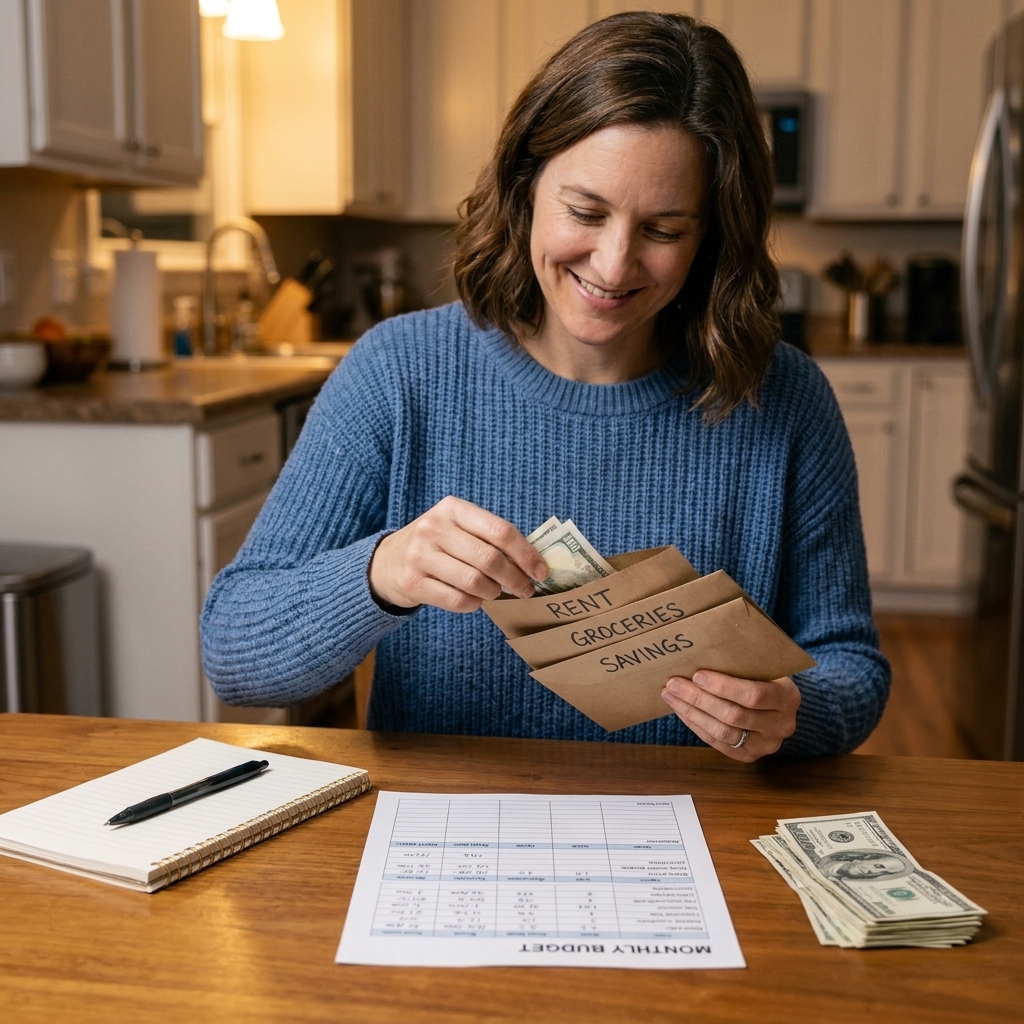
The cash envelope system is a budgeting method where you set aside physical cash for specific spending categories, usually the discretionary ones. Each category gets an envelope. When the envelope is empty, you are done spending in that category until the next budget period.
It is basically giving your budget guardrails you can actually feel.
What it looks like
- You budget $400 for groceries for the month.
- You withdraw $400 in cash.
- You put that cash in a “Groceries” envelope.
- You only buy groceries with that cash.
- If the envelope is running low, you adjust your choices. If it is empty, you stop, or you move money from another envelope intentionally.
Why cash can help
I love budgeting apps, and I still use spreadsheets. But for many of us, swiping a card does not register as real spending in the moment. Cash often does. Behavioral economists sometimes call this the “pain of paying” effect: handing over money can feel more tangible than tapping your phone.
1) Cash creates a pause
With a card, spending is frictionless. With cash, you have to open the envelope, count bills, and hand money over. That small pause is often enough to ask, “Do I actually want this?”
2) Cash makes tradeoffs obvious
If you have $22 left in your dining out envelope, it becomes crystal clear that ordering delivery twice will blow it up. A card lets you pretend future-you will deal with it.
3) Cash gives you a finish line
Many budgets fall apart because they stay abstract. Envelopes give you a visible boundary that is hard to ignore and easy to follow.
Who it works for
This method is especially helpful if:
- You tend to overspend on flexible categories like dining out, groceries, fun, or personal spending.
- You are trying to break the paycheck-to-paycheck cycle and need clearer limits.
- You and a partner share money and want a simple way to stay aligned.
- You feel shame after spending and want a neutral system that keeps you on track without constant willpower.
It might not be the best fit if you are paid irregularly and do not want to handle cash often, or if most of your spending is fixed bills that are already automated. (You can still use envelopes for just a few categories, though.)
Best envelope categories
Use cash for categories where you have the most wiggle room and the most “oops” spending. Most people do best starting with 3 to 6 envelopes.
Good starter categories
- Groceries
- Dining out
- Fun money (entertainment, outings, hobbies)
- Personal spending (clothes, haircuts, skincare, random Amazon)
- Gas (if you tend to mindlessly top off or grab extras)
- Kids (activities, school events, little extras)
A quick gas note: cash can be slightly annoying at some stations (prepay rules, pay-at-the-pump holds, or just the general hassle). If it feels like a speed bump, make gas a tracked category instead of a cash envelope, or keep it as a smaller “inside purchases” envelope.
Usually stay digital
- Rent or mortgage
- Utilities
- Insurance
- Debt payments
- Subscriptions you are keeping
Keep it simple: use envelopes where cash will change your behavior, not everywhere just to prove you can.
How to set it up
You can do the basic setup in one quick session. Once you have done it once, monthly refreshes are fast. The first time may take longer if you need a bank run or you are tweaking categories.
Step 1: Pick your budget period
You can do monthly, but many people find it easier to start with weekly envelopes, especially for groceries and dining out.
- Monthly feels simple, but it is easier to burn through cash early.
- Weekly gives you a reset and helps you pace spending.
Step 2: Pick your amounts
Look at the last 1 to 2 months of spending and choose a number that feels realistic, not perfect.
If you do not know what to pick, start with a “good enough” baseline and treat the first month as information gathering.
Step 3: Withdraw cash
Go to your bank, withdraw in a mix of bills, and ask for smaller denominations if you need them. Having only $20s can be annoying and can accidentally encourage overspending.
Step 4: Label and stuff
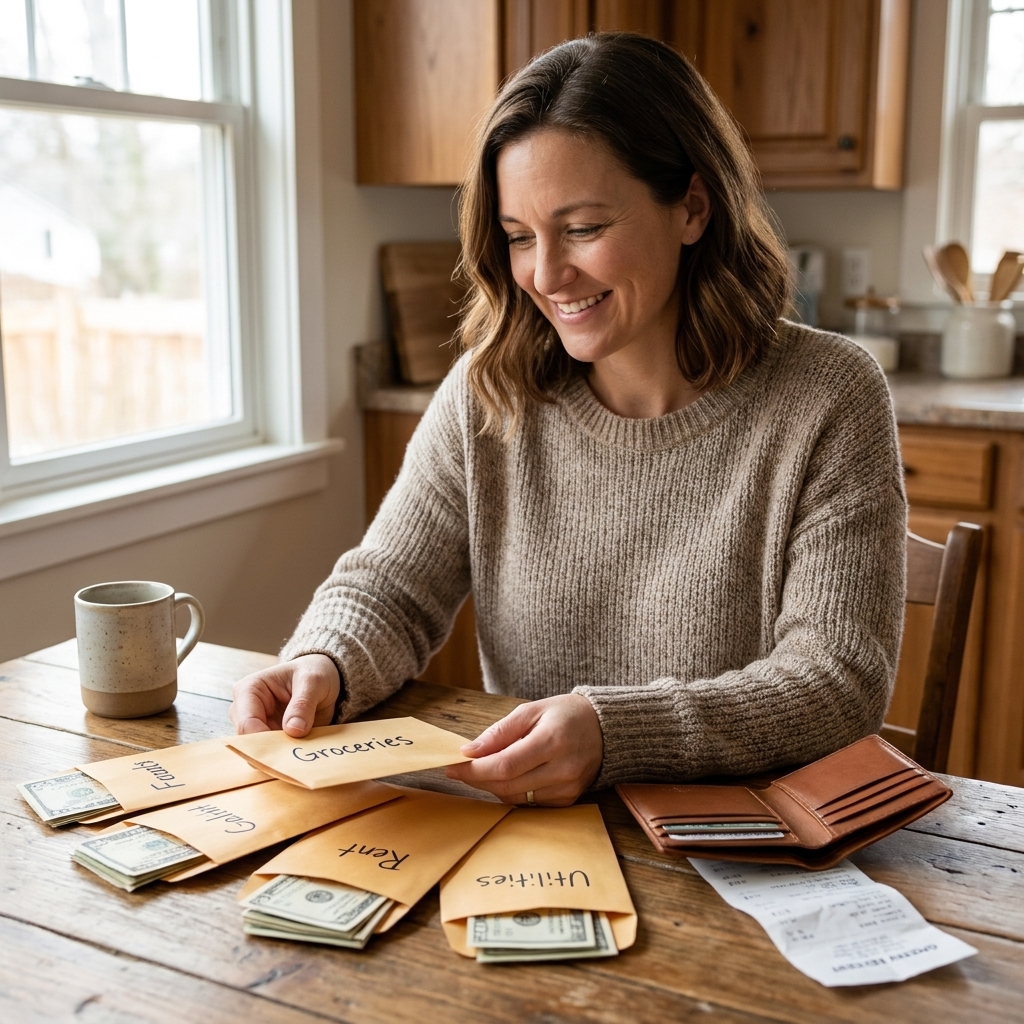
Use paper envelopes, a small accordion file, or a simple cash wallet. Label each category and add the cash.
Step 5: Decide your “forgot cash” rule
This is where most people accidentally break the system. Choose one rule and stick to it:
- Strict rule: If you forgot cash, you do not buy it.
- Flexible rule: You may use a card, but you must “match” the purchase right away by (1) writing it on the envelope, and then either (2) depositing that cash to checking within a day or two, or (3) reducing your next cash withdrawal by that amount. The point is to keep the category honest.
How to avoid deprivation
The goal is not to make you miserable. The goal is to make spending intentional.
If you feel restricted
- Add a “Treats” envelope. Even $20 to $40 a month can lower the urge to rebel spend.
- Use smaller, more frequent stuffing. Weekly cash feels less scary than a big monthly amount.
- Plan your “yes” purchases first. If you love coffee out, budget for it on purpose instead of trying to white-knuckle it.
I used to think budgeting meant punishment. The truth is, budgeting is permission. Envelopes just make the permission crystal clear.
When an envelope is empty
This is the moment the system actually works. You have three options, and only one is “wrong.”
Option A: Stop
If dining out is empty, you eat at home. This is the cleanest option, and it builds confidence fast.
Option B: Move money intentionally
This is allowed, as long as you are honest about the tradeoff. Pulling $30 from “Fun” to cover groceries means less fun later. That is real life.
Option C: Put it on a card and pretend it is fine
This is the option that breaks the method. If you do this, do not beat yourself up. Tighten your “forgot cash” rule and keep going.
What to do with leftovers
Leftover money is a win, and you get to choose how it helps you most. Here are strong options.
- Roll it over to next month if the category is naturally uneven (like groceries).
- Move it to a goal like an emergency fund, sinking fund, or debt payoff.
- Split it: half to a goal, half to fun. This is a great motivation trick.
Hybrid options
Not everyone can use cash for everything. Some places are card-only, and online spending is real life. A hybrid system keeps the benefits without making you jump through hoops.
Hybrid ideas that work
- Cash for your top 2 problem categories (often groceries and dining out).
- A “Card Envelope” for online spending: set a weekly cap (say, $25), keep a running note in your phone, and stop when you hit it. If you need a reset, you reset next week, not tomorrow.
- One debit card for one category: load a separate checking account (or prepaid debit card) with your monthly fun money.
The magic is not the paper envelope. The magic is the hard boundary.
Couples and families
If you share money, envelopes can reduce a lot of the low-grade tension.
- For shared grocery trips: decide who carries the grocery envelope, or keep it in a known spot so it always makes it into the wallet before a store run.
- For personal spending: give each person their own envelope, no commentary attached.
- For categories that cause fights: start there first. Dining out is a classic one.
Cash safety basics
Cash is simple, but you do want to be smart about it.
- Do not carry every envelope everywhere. Bring what you need and keep the rest at home.
- Store house cash securely. A lockbox, a filing cabinet, or another consistent out-of-the-way spot is better than a junk drawer.
- Keep a small buffer in checking. Even a little cushion can prevent the “fine, I will just put it on the card” spiral.
Common mistakes
Too many envelopes
If you have 17 envelopes, you will burn out. Start small, build the habit, then add categories if you truly need them.
Amounts that are too low
If your grocery spending is $650 and you set an envelope for $350, you are not being “disciplined.” You are setting up a mid-month panic. Reduce gradually.
Overtracking (or no check-in at all)
You do not need to log every penny. A simple weekly check-in is enough: count what is left in each envelope and jot one note about what surprised you. If receipts help you remember where it went, keep them for the week and toss them after your check-in.
Using credit cards as the backup plan
If you are paying off debt, this can undo progress fast. If you need a safety net, build a small buffer in checking or a mini emergency fund first.
Quick start week
- Pick 3 categories: groceries, dining out, personal spending.
- Choose weekly amounts: start with what you normally spend, then trim later.
- Withdraw cash for one week only.
- Use cash all week. No exceptions, or use the “match the card purchase” rule.
- Do a 10-minute review: What was easy? What was hard? Which envelope surprised you?
One week is enough to feel the difference. You will learn more from seven days of trying than from seven more days of thinking about it.
FAQ
Is it safe?
It can be, with common sense. Do not carry every envelope everywhere. Keep most at home and only bring what you need. If you are uncomfortable with cash, use envelopes for smaller amounts or switch to a separate debit account for those categories.
Should I use this while paying off debt?
Yes, especially for overspending categories. Envelopes can help you stop creating new debt while you pay down the old stuff.
How much cash should I start with?
Start with one week of cash for 2 to 4 categories. It feels manageable and helps you adjust quickly.
What if my partner hates cash?
Try a split approach: cash for your personal categories, and a shared digital tracker for household categories. Or do envelopes only for the joint category that causes the most tension, like dining out.
Bottom line
If overspending keeps sneaking up on you, it is probably not a “discipline problem.” It is a system problem. The cash envelope method works because it turns invisible spending into something you can see, touch, and pace.
Start small. Pick the two categories that always blow up your budget. Give them cash. And the next time you feel tempted to swipe, let the envelope answer for you.